GuideThe game, step by step
How to Play Baccarat Online: the Rules for Beginners, Hand by Hand
Baccarat is a game where the house makes all the choices. You only decide where your money goes, and if you are learning how to play baccarat, that one decision before the cards come out is what sets the cost of the session.
How does baccarat work?
So how does baccarat work? It is a card game dealt from a shoe of six or eight standard decks, where the only objective is to guess which of two hands will finish with a point total closest to nine.
The two hands are called Player and Banker. These are just labels painted on the felt. The cards are drawn according to a rigid set of rules that dictate exactly when a side must take another card and when it must stand. That is the game.
The Player hand shows a five and a king, the Banker hand a seven and a king, and a third card arrives for the Player side before you have even settled into your chair. The Banker stands on a seven, the dealer sweeps the losing chips away, and a new round begins immediately. If you are new to it, the speed can feel like a blur. Unlike blackjack, there are no strategy charts to memorise and no decisions to make about splitting pairs or doubling down while the rest of the table stares at you. You place your wager, take your hands off the felt, and let the mathematics take their course.
When you approach a table, you will see betting areas marked for Banker, Player and Tie. You place your chips in one of these boxes before the dealer announces that no more bets are accepted. From that moment on, you have no input. You do not decide whether to hit or stand. You do not hold the cards. The dealer pulls the cards from the shoe, places them face up on the table and announces the totals. If your chosen side totals closest to nine, you receive a payout. If the other side is closer, your chips are taken.
The version dealt at UK tables, in card rooms and online, is punto banco, named after its two hands. The dealer shuffles the cards, places them in a plastic shoe and completes the burn: the first card is turned and that many cards are burned, with a ten or picture card counting as ten. The full procedure, cut card included, is on our baccarat rules page.
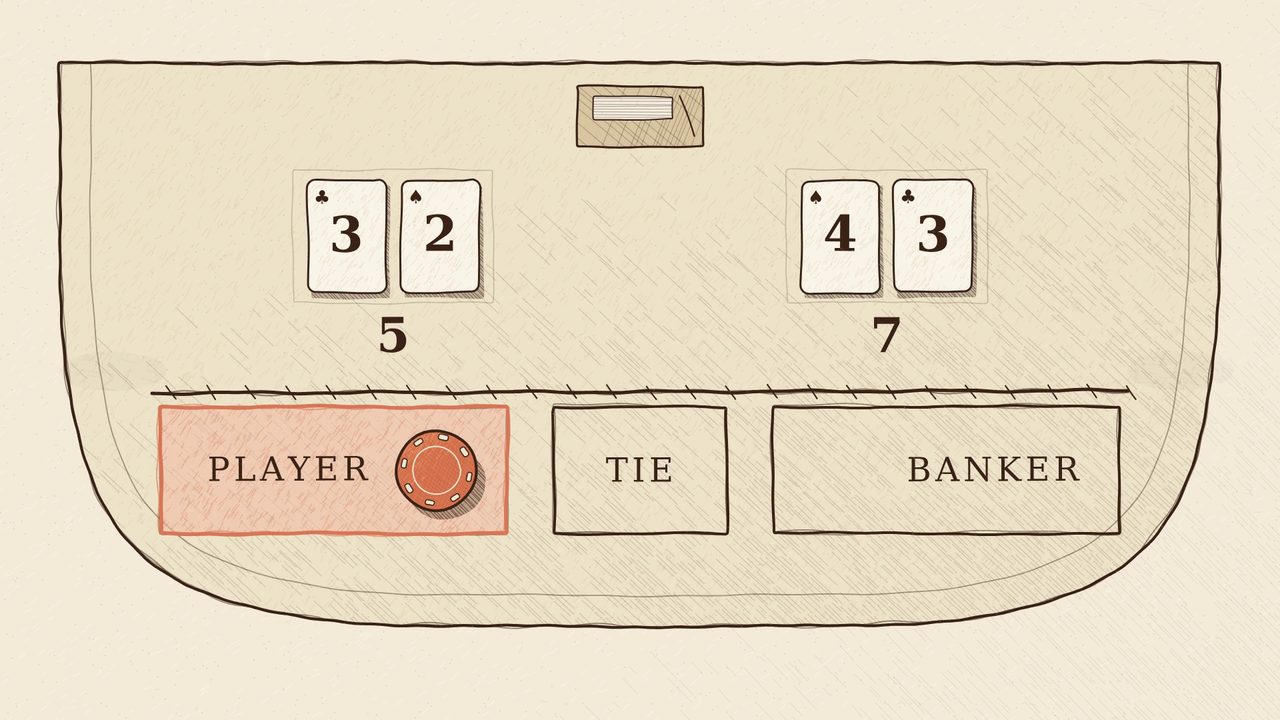
Read the narration
Baccarat is a game where the house makes all the choices. You only decide where your money goes. Player, Banker, Tie. The Player hand is not yours, and the Banker hand is not the casino's. The chip goes down, the window closes, and from that moment on, you have no input. Player has 3 and 2, five. Banker has 4 and 3, seven. No natural. Player draws on 0 to 5, and takes a 6. Eleven counts as 1. Banker's 7 stands. Banker wins, 7 to 1. Banker acts last, so it wins slightly more often, which is why a winning Banker bet pays 5 per cent commission. The one decision you made has a price. Banker costs 1.06 per cent, Player 1.24. The Tie, at 8 to 1, costs 14.36 per cent. Backing it because a tie has not happened in a while changes nothing. The odds do not change. No rule or system changes the edge.
Please gamble responsibly. GambleAware.org 18+
Card values and how a total is counted
Cards two to nine are worth their face value, aces count as one, and tens, jacks, queens and kings have a value of zero.
To follow the action on the table, most beginners first learn the baccarat card values. Because only the rightmost digit matters, no hand can ever exceed a total of nine. If a hand receives a seven and an eight, the total is fifteen. You drop the first digit, leaving a total of five. If a hand receives a six and a four, the total is ten, which becomes zero. A zero total is often called baccarat, the worst hand you can hold.
Take an example from the felt. The dealer slides a queen to the Player box and a three to the Banker box. The queen counts as nothing, so the Player sits on zero. The next cards are a nine for Player and a five for Banker. The Player total is now nine and the Banker total is eight, both naturals, and Player wins nine to eight. If a third card is drawn, the same counting rule applies: a Player hand holding a two and a three draws a seven, the total is twelve, and it drops to two. You never have to worry about busting.
The best possible outcome is a total of eight or nine on the first two cards. This is known as a natural. If either the Player or the Banker is dealt a natural, the round ends immediately and neither side draws a third card. The higher natural wins, or the hands tie if they hold the same total.
You do not need to calculate the totals yourself because the dealer announces them. A king and a nine make a natural nine. A two and a three, followed by a four, also make nine, but that is not a natural. The suits of the cards do not matter in any way.
| Card | Value | Example hand | Total |
|---|---|---|---|
| Ace | 1 | Ace + 6 | 7 |
| 2 to 9 | Face value | 4 + 3 | 7 |
| 10, J, Q, K | 0 | Queen + 8 | 8 |
| Any two over 9 | Drop the tens digit | 9 + 7 = 16 | 6 |
How to play baccarat online, one round at a time
If you are figuring out how to play baccarat online, the sequence of events mirrors a physical table. You open the game, select your chip size and click on a betting position.
- 01
Choose your chip and place it on Player, Banker or Tie before the betting window closes.
- 02
Two cards go to Player and two to Banker, dealt alternately from the shoe.
- 03
If either hand totals 8 or 9, that is a natural: the round stops and the higher total wins.
- 04
Otherwise Player draws a third card on a total of 0 to 5 and stands on 6 or 7.
- 05
Banker then draws or stands according to the drawing chart, which looks at Banker's total and at Player's third card.
- 06
The higher total wins. Winning bets are paid; on a Tie, Player and Banker stakes are returned.
Step through a hand
- Two cards each. Player has 3 + 2 = 5, Banker has 4 + 3 = 7. Neither has an 8 or 9, so there is no natural and the drawing rule takes over.
- Player draws on 0 to 5. Player's 5 takes a third card, a 6: 5 + 6 = 11, which counts as 1. Banker's 7 stands whatever Player drew. Banker wins, 7 to 1.
- A natural stops the hand. Player is dealt 4 + 4 = 8, a natural. Nobody draws, even though Banker's 5 + 2 = 7 would normally stand anyway. Player wins, 8 to 7.
- Player stands on 6, Banker draws on 0 to 5. Player has K + 6 = 6 and stands. Banker has 2 + 3 = 5 and, with Player standing, draws: a 3 makes 8. Banker wins, 8 to 6.
- Banker on 3 draws unless Player's third card is an 8. Player has 2 + A = 3 and draws an 8: 11, counted as 1. Banker has A + 2 = 3 and stands against that 8. Banker wins, 3 to 1.
- Banker on 6 draws only against a Player third card of 6 or 7. Player has 10 + K = 0 and draws a 7. Banker has J + 6 = 6, so against a 7 Banker draws: a 2 makes 8. Banker wins, 8 to 7.
The first card goes to the Player box, the second to the Banker box, the third to Player and the fourth to Banker. Both sides now have two cards. If neither side has a natural eight or nine, the third-card rules are applied. The Player hand always acts first; once it is resolved, the Banker hand takes its turn. The final totals are compared, and the dealer pays the winners and collects from the losers. Watch a round dealt step by step, from the first card to the payout.
You can play baccarat online live with a human dealer broadcasting from a studio. The mechanics are identical, but the pacing is slower. Some live squeeze tables stretch the tension with a slow reveal. The drawn card does not change because they take their time. You pay for the theatre with your time.
If you prefer a faster pace, a random number generator handles the deck instantly. In a digital game, you control the pace: the cards are only dealt when you press the button. This is useful if you are learning how to play baccarat online without the pressure of a betting timer.
Practise a hand
Play money: no real money, not gambling. This table is here to show the deal and the drawing rules in action, one hand at a time.
Put a chip on Player, Banker or Tie and deal. The table uses an eight-deck shoe, the standard third-card rules and the usual payouts: Player 1:1, Banker 0.95:1 after the 5 per cent commission, Tie 8:1 with Player and Banker bets returned.
After each hand a line under the cards says who drew a third card and why, so you can check it against the drawing chart further down. The chips have no value: they cannot be bought or cashed out, and they reset when you leave the page. Practising does not change the odds of any real game.
Practice table
18+Play money: no real money, not gambling
Chips 1,000
The practice table needs JavaScript. The step-through above shows the same rules without it.
Eight decks, reshuffled near the end of the shoe. Banker pays 0.95:1, Tie pays 8:1 and returns the Player and Banker bets. The chips are play money and reset when you leave the page.
The third-card rule for beginners
The drawing rules in this game are entirely automatic. The dealer memorises them, and the software applies them without error.
The Player rule is straightforward. If the Player hand has a total of zero, one, two, three, four or five on the first two cards, the Player must draw a third card. If the Player hand totals six or seven, the Player must stand. The Player never draws a fourth card.
The Banker rule is more complex because the Banker acts last, and because it acts last it wins slightly more often: 45.86 per cent of hands against 44.62 per cent for Player over eight decks, with 9.52 per cent ties. If the Player stands on a six or seven, the Banker follows the simple rule and draws on a total of zero to five, standing on six or seven.
When Player has drawn a third card
If the Player takes a third card, the Banker consults a fixed grid based on two factors: the Banker's current total and the value of the third card drawn by the Player.
If the Banker has a total of zero, one or two, the Banker always draws, regardless of what the Player drew. On three, the Banker draws unless the Player drew an eight as their third card. On four, the Banker draws if the Player drew a two, three, four, five, six or seven, and stands on zero, one, eight or nine. On five, the Banker draws if the Player drew a four, five, six or seven. On six, the Banker draws only if the Player drew a six or a seven. On seven, the Banker always stands.
The full grid, cell by cell, sits on our baccarat rules page.
The three bets and the odds behind them
Every betting choice you make has a price attached, and the price is the house edge: how much of your stake the casino expects to keep over thousands of rounds.
No rule or system changes the edge; you can only choose the cheaper bet. The Player bet carries a house edge of 1.24 per cent. For every £100 you stake on Player over time, the casino expects to retain £1.24, and you are paid at even money if the Player hand wins.
The Banker bet carries a house edge of 1.06 per cent. It costs you £1.06 per £100 staked. Because the Banker wins more often than Player, casinos apply a five per cent commission to all winning Banker bets.
The little plastic commission box in front of the dealer puzzles many newcomers. A winning Banker bet pays slightly less than the stake in profit, because the Banker acts last and therefore wins more often. Even with the five per cent commission deducted, the Banker bet remains the cheapest option on the table.
The Tie bet pays eight to one if the two hands finish on the same total, and carries a house edge of 14.36 per cent: £14.36 per £100 staked. Some tables pay the Tie at nine to one, which cuts its house edge to 4.84 per cent, but eight to one is the usual payout. You might also see a no-commission variant, where Banker wins pay even money except a Banker win on six, which pays half; that lifts the Banker edge to 1.46 per cent, so it costs more than the commission version. The Banker bet at a standard five per cent commission table is the cheapest of the three.

| Bet | Pays | Wins | House edge |
|---|---|---|---|
| Banker | 1:1 less 5% | 45.86% | 1.06% |
| Player | 1:1 | 44.62% | 1.24% |
| Tie | 8:1 | 9.52% | 14.36% |
| Tie, where offered | 9:1 | 9.52% | 4.84% |
Own exact calculation over all card orders of an eight-deck shoe. Change the deck count and payouts in the house edge calculator.
Playing baccarat online: RNG and live tables
If you decide to play baccarat online for real money, operators offer software versions and live studio feeds. Both use the same rules and carry the same house edge.
How does baccarat work online, then? Exactly as it does on the felt. An RNG table deals when you press the button and lets you go at your own pace. The interface on a digital table is usually stark and simple: you select a chip, click the Banker circle to place it, and then click the deal button.
A live baccarat table is streamed from a studio with a real dealer and shoe, and runs on a betting timer. Once the timer runs out, betting is locked and the cards are drawn. You can sit out a live round simply by not betting.
Any operator offering real-money tables to players in Great Britain has to carry a UK Gambling Commission licence, and you can look up its licence number on the regulator's public register. You must be eighteen and verify your age and identity before you deposit. Our real money baccarat guide covers what happens after that.
Beginner mistakes worth avoiding
Beginners rarely get the rules wrong, they get the betting wrong.
- The side bet. Modern tables offer wagers on pairs and margins of victory. A Player Pair paying 11 to 1 carries a house edge of 10.36 per cent, about ten times the Banker bet.
- Looking for patterns. The screens of red and blue circles are called the roads, and people stare at them waiting for a cluster to break. Each hand is dealt from what is left in the shoe; the roads record the past, they do not forecast. A long run of Banker wins means nothing for the next hand.
- Betting the Tie because a tie has not happened in a while. The odds do not change. The edge remains at 14.36 per cent.
- Assuming a no-commission table is cheaper. The Banker edge rises to 1.46 per cent against the standard 1.06 per cent, because a Banker six pays half.
You only get one decision per round. Banker is the cheapest, so ignore the roads and leave it at that. If you step up to the table looking for complexity, you will usually end up paying for it. The numbers behind every bet are worked out on our baccarat odds and strategy page.
Questions beginners ask about how to play baccarat
Is baccarat a game of skill?
No, it requires no skill. The rules dictate every draw and you make no playing decisions.
What does a natural mean in baccarat?
A two-card total of eight or nine. The round ends immediately and no third card is drawn.
Why is there commission on the Banker bet?
Because Banker wins more often. The Banker acts last, so the casino takes five per cent of a winning Banker bet to keep its edge.
What happens if there is a tie in baccarat?
Banker and Player bets are returned. A bet on the Tie itself usually pays eight to one.
How many decks are used in baccarat?
Usually eight. You might occasionally find a six-deck shoe.
Can you play baccarat online in the UK?
Yes, at a site licensed by the UK Gambling Commission. You must be eighteen or older and verify your age and identity.
How does baccarat work?
You bet on which of two hands gets closest to nine. The cards are drawn according to a fixed set of rules.
How do you play baccarat online?
Place a chip on Player, Banker or Tie at a licensed site. The software or the live dealer handles the rest.
How do you play the baccarat card game?
Choose a betting position before the cards are dealt. The dealer then deals by the rules and pays the winners.
Where can I play baccarat online?
At a site licensed by the UK Gambling Commission. Check its licence number on the Commission's public register.
What is the first step in a baccarat game?
Pick Player, Banker or Tie before the deal. The rules do the rest, and you are paid if your side finishes nearest to nine.
How do you play real money baccarat online?
Verify your age and identity, then deposit with a debit card or bank transfer. Credit cards have been banned for gambling in Great Britain since 14 April 2020.
What are the card values in baccarat?
Aces one, two to nine face value, tens and pictures zero. Only the last digit of a total counts.
When does the Player draw a third card?
On a total of zero to five. Player stands on six or seven.
Is no-commission baccarat cheaper?
No, the Banker edge rises to 1.46 per cent. A winning Banker six pays only half.